



If you've ever heard these phrases in your organization, you're experiencing this problem:
- "The product team didn't deliver this—that's why they churned."
- "The CSM team didn't tell us about this early enough."
- "We built exactly what they asked for and they still aren't using it."
The typical broken process fails in both directions. Sometimes the CSM pushes for a feature because a buyer requested it—often with a deadline attached. The PM builds based on secondhand information without talking to actual end-users, missing critical context that direct discovery would have revealed. Other times, the PM drives a visionary feature that represents where the market is heading, building something strategically sound but ahead of where customers currently are.
Either way, the result is the same.
As Harrison Shalhoub Connor, ex Ecosystem Lead of Immutable notes: "Sometimes, features are launched at the wrong time and customer success has to bear the brunt when product priorities don't align with where the customers are at. Even customers who requested specific features may not be ready when delivered. They are often contextually at the wrong time even when there is interest."
When CSMs push for features, customers who demanded them six months ago may now be dealing with internal changes, competing priorities, or unfinished groundwork. When PMs drive visionary features, customers often lack the organizational maturity or workflows to adopt them. The feature is strategically right but tactically premature.
The result? CSMs explain why the feature their client demanded still isn't being used—or worse, defend why the product team built something 'nobody asked for' when customers are struggling with basics. The PM either delays the roadmap to rework it, or moves on while the feature sits unused. In both cases, the CSM bears the brunt of the misalignment.
Nobody wins. The customer doesn't get value. The CSM doesn't get their renewal. The PM burns credibility and roadmap bandwidth. And adoption suffers across the board.
The Real Cost of the Adoption Gap
This broken dynamic creates costs that multiply across your business:
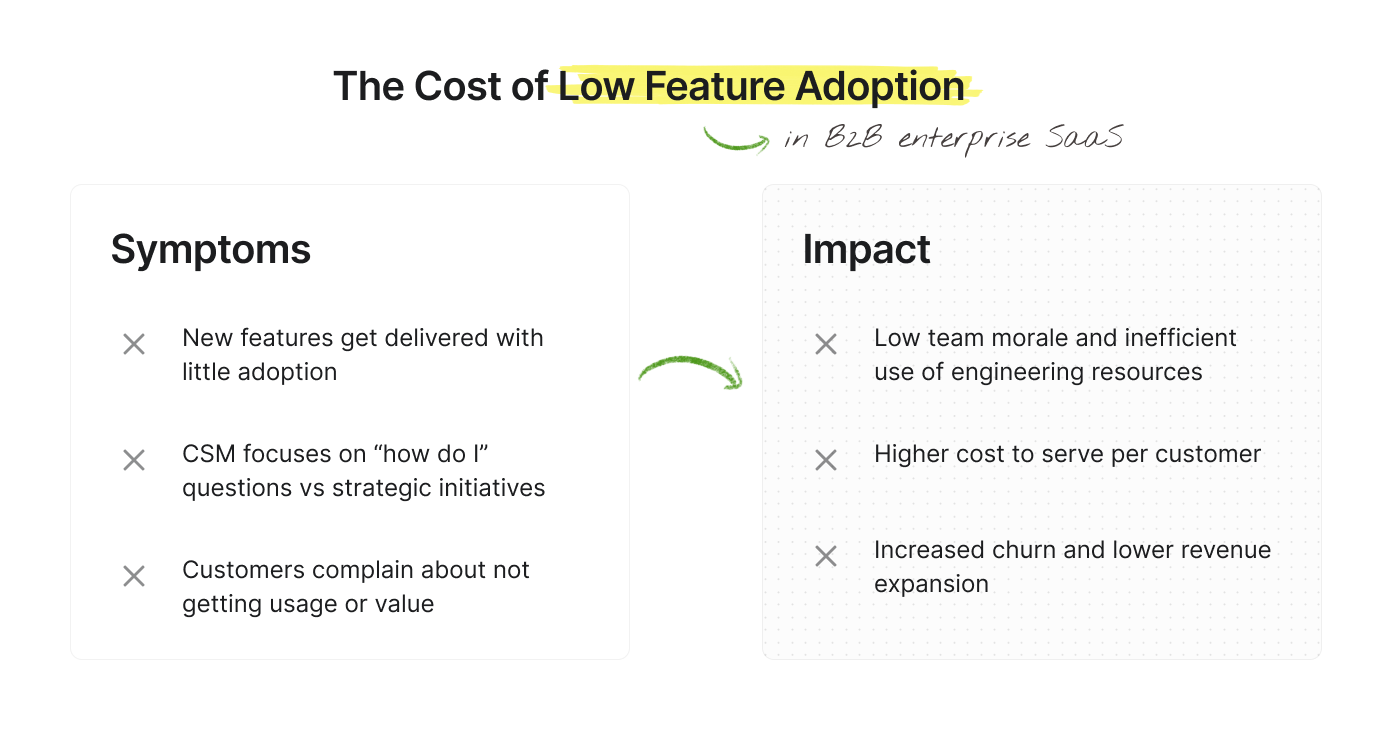
- Low feature adoption becomes a product quality problem. Your most valuable, differentiated features sit unused because users don't discover them or understand how they solve their problems. But here's the insidious part: when features don't get adopted, you can't learn whether they actually solve the problem. Your product feedback loop breaks down, leading to more features built on faulty assumptions. The cycle compounds.
- Reactive CSM teams drive up cost-to-serve. Your best CSMs spend their time on "how do I..." questions and workarounds instead of driving strategic account expansion. You end up hiring more CSMs just to maintain activation rates, inflating your cost structure while your unit economics deteriorate. Meanwhile, the strategic work that actually drives expansion—identifying upsell opportunities, building executive relationships, proving ROI—gets pushed aside. User turnover at client companies compounds the problem. As Cindy notes, "It's always been challenging when clients experience attrition and new users join—even with prior experience, they need to take quite a bit of time to really understand the existing setup." Each time a client's team changes, your CSMs restart the enablement cycle, further cementing them in reactive mode.
- Engineering resources get burned on rework and abandoned features. Product teams build features based on incomplete information, leading to significant rework cycles or features that simply get abandoned when adoption never materializes. Every hour spent rebuilding Feature A is an hour not spent on Feature B that might actually move the needle. Your velocity drops, your engineers get frustrated, and your competitive advantage erodes.
- Customers churn for the wrong reasons. They leave not because your product can't solve their problems, but because they never discovered it could. Your win-loss analysis shows "missing features" as a churn reason, so you build more features—but you're solving the symptom, not the disease.
As Harrison points out, the instinct to hire more people is exactly the wrong response: 'Putting more people to the problem is not the solution if you have a broken process. It just results in you bleeding cash.' Each new team member you hire inherits the same structural dysfunction—CSMs spend their time firefighting instead of driving expansion and engineers continue building features that don’t drive revenue.
