



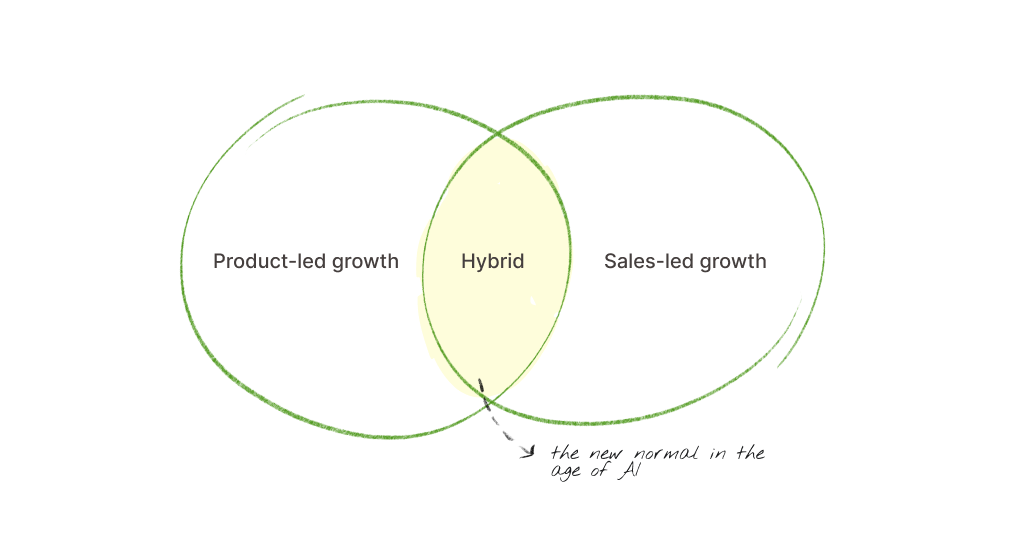
Even before AI transformed the landscape, smart companies were already moving toward hybrid models. The shortcomings of pure PLG and pure SLG were too obvious to ignore. What was once a strategic choice has become a necessary move for every B2B SaaS.
AI fundamentally changed what products need to deliver value. Configuration complexity exploded—products now require company data, workflow integrations, and custom guardrails before they work. Use cases multiplied beyond anything you could pre-template—your tool can now solve problems across personas you never designed for. This complexity demands human guidance to unlock.
But here's the trap: the obvious solution is to hire armies of salespeople and CSMs to handle this complexity. That just recreates the exact problems killing pure SLG—unsustainable costs, quality degradation at scale, and burning cash on people who can't keep pace with exponentially growing product capabilities.
The challenge isn't choosing between human support and self-serve anymore. It's architecting a system where both work together without the downsides of either.
The PM's Survival Guide: Building Hybrid That Actually Works
The answer isn't more people or better self-serve—it's intelligently orchestrating when each approach matters.
White Glove Where It Matters
Not every user needs human support, but some moments are make-or-break. Decision-makers signing contracts need trust-building conversations. Champions configuring integrations need implementation guidance. Power users customizing workflows need strategic alignment on how AI transforms their operations.
These aren't "help me find a button" moments—they're high-stakes decisions that determine whether your product gets adopted or becomes shelf-ware. Deploy humans here, ruthlessly. But only here.
Self-Serve for Feature Adoption and Expansion
Once the foundation is set, PLG principles determine whether you survive renewal. Individual contributors need to onboard themselves, discover features organically, and expand usage without friction. Your tool only lives if it's unlocking daily value—and daily value requires removing every barrier between users and activation.
This is where intuitive design, progressive disclosure, and viral loops matter. Don't make users ask for permission to try a feature. Don't gate value behind sales calls. Let the product prove itself.
AI as the Orchestrator
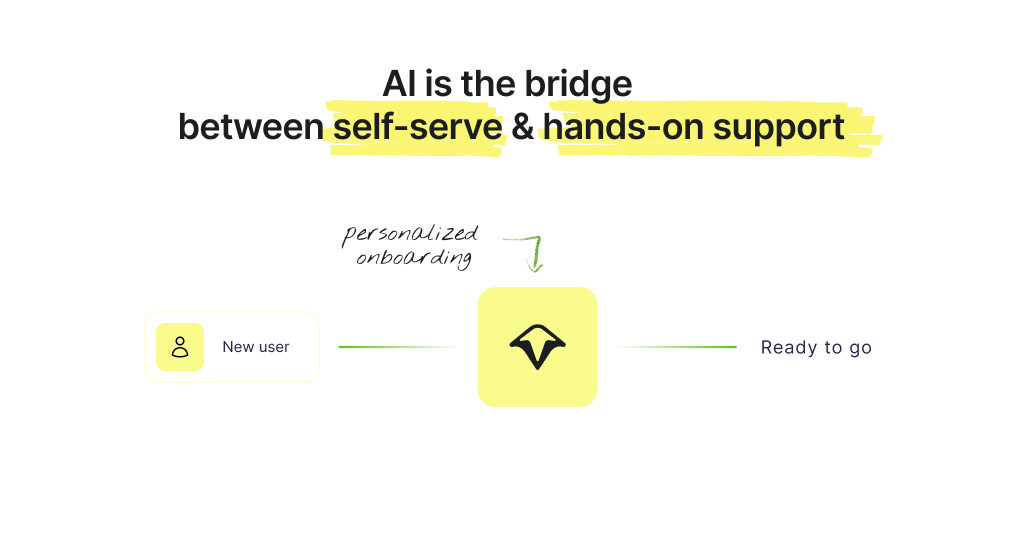
Here's the breakthrough: AI can operate in the space between white glove and self-serve, providing personalized guidance at scale without human cost.
AI can surface the right features for each user's specific context—replicating what great CSMs do but for everyone simultaneously. Tools like Quarterzip can onboard users conversationally, understanding their role, goals, and workflow to provide tailored guidance that feels white-glove but scales like self-serve.
Most importantly, AI solves the information asymmetry problem that made sales valuable while maintaining the efficiency that made PLG attractive. It can:
- Explain complex capabilities in context
- Suggest relevant use cases based on user behavior
- Adapt to each user's sophistication level
- Know when to surface human support vs. let the product speak for itself
This isn't replacing humans or eliminating self-serve—it's making both more effective by filling the gaps between them.
Master the Handoff
The companies that win won't have the best sales team or the smoothest self-serve flow—they'll have the best orchestration between all three.
Define clear triggers:
- Human to AI: When does a sales-assisted customer transition to AI-guided usage?
- AI to Human: What signals should escalate users to human support? (Complex customization, expansion opportunities, risk of churn)
- Self-serve to AI: Which support needs can AI handle without degrading experience?
Build systems that make these transitions invisible to users. They shouldn't feel like they're being passed around—they should feel like they're getting exactly the right help at exactly the right time.
