
The Death of Pure PLG
When was the last time you could confidently announce that your company was "product-led" or "sales-led" without immediately adding qualifications?
That clarity vanished somewhere between your expansion into enterprise and watching your self-serve funnel collapse under AI complexity. You're not confused—you're simply experiencing the death of the binary choice that defined a decade of SaaS strategy.
PLG companies hit walls when they expand to enterprise. Sales-led companies burn cash trying to drive adoption and reach mid-market. And now AI has arrived to make both approaches feel like relics from a simpler era.
To understand why we're all becoming hybrid sellers by necessity—and what that means for your survival as a PM—let's examine how we got trapped between two dying motions and how we can come out on top.
The Death of Pure PLG
As a young, naive product manager in the 2010s, product-led companies were the place to be. The early 2010s gave us a new playbook written by companies like Slack, Dropbox, and Atlassian. They proved you could bypass procurement, empower individual users, and let viral adoption do the selling. The pitch was irresistible: build a product so intuitive that users onboard themselves, expand organically, and convert without a sales call. Reduce CAC to near-zero. Scale infinitely.
This wasn't just a go-to-market strategy—it was a philosophy. User empowerment over gatekeeper navigation. Freemium over demos. Land and expand over enterprise deals. The consumerization of B2B software meant buyers expected the same frictionless experience they got from consumer apps. VCs loved the unit economics. Users loved having instant access to the product.
But even the greatest PLG companies eventually hit a wall.
The One-Size-Fits-All Fallacy
PLG assumed users could figure out how your product fits their needs. This worked when people had predictable use cases—or at least, the top few use cases software needed to solve for. Project management has obvious patterns, design tools have standard workflows, and the design patterns were being established.
But as B2B SaaS usage became prolific and customers matured, this one-size-fits-all fallacy started to show its cracks. Every customer and organization began to diverge in terms of maturity and complexity. All of a sudden, your project management tool was no longer just helping people collaborate on projects—more specific use cases for finance teams, development teams, and marketing teams started to emerge. Your self-serve onboarding flow could no longer handle it.
Self-serve Meets AI Complexity
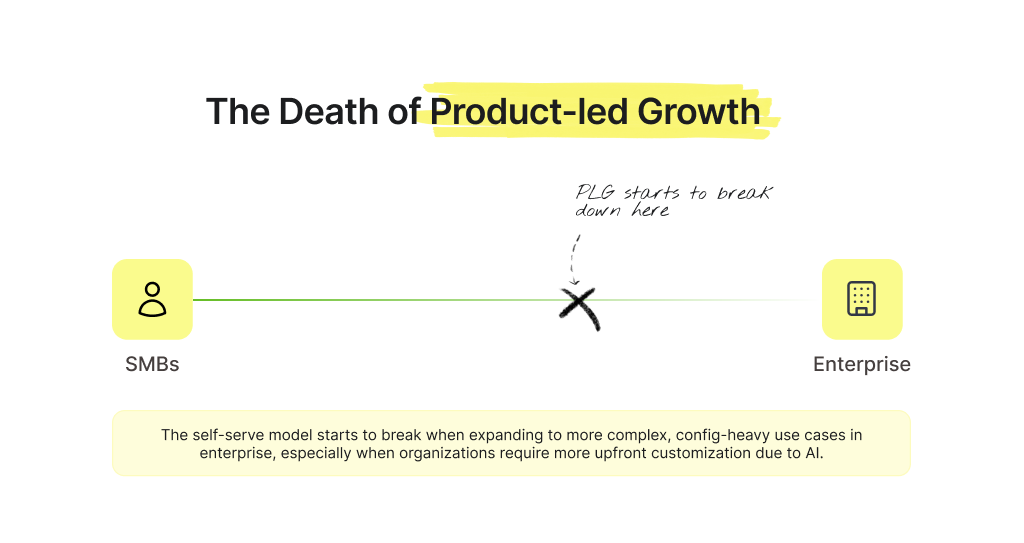
Self-serve just doesn't work for everyone. The reality is your biggest enterprise customers needed configuration, security reviews, custom integrations, and a human being to convince their procurement department.
Now AI has accelerated this problem exponentially. Modern AI-powered products require significant upfront configuration: training on company data, setting up integrations, defining workflows, establishing guardrails. The "sign up and start using it in 30 seconds" promise collapses when activation requires feeding your product three months of customer conversation history.
The companies still succeeding with pure PLG are the ones solving problems that don't require upfront context. For everyone else building in AI, self-serve is becoming a luxury you can't afford.