How do they compare?

Quarterzip vs Cora AI

Compare Quarterzip and Cora AI: the interface for AI diffusion versus CSM workflow automation. See which approach fits the activation problem you're solving.

How Quarterzip and Cora AI compare
What your business needs
Guidance model
Guidance model
Proactive agents lead the conversation in real time
Workflow automation that acts on customer signals - no direct user guidance
Interface
Interface
Voice and screenshare, multi-modal
CSM-facing dashboards and workflow triggers - not user-facing
AI capabilities
AI capabilities
Native voice agent with computer vision, multi-modal conversation
Agentic automation across CS channels and workflows
Cross-app support
Cross-app support
Yes, across browser tabs and third-party tools
Connects to post-sales stack via integrations - not present in the user's workflow
Time to live
Time to live
Two weeks, done-for-you
Implementation varies by stack and scope
What you learn
What you learn
Customer goals, friction points, qualitative reasoning✕Health signals, usage
Health signals, usage patterns, churn risk - no qualitative session context
Pricing
Pricing
Fixed monthly, unlimited usage
Varies by implementation scope and integrations
Want to see activation in action?
Why do companies choose Quarterzip over Cora AI?
Both Cora and Quarterzip are working on AI diffusion, but they’re working on it from different ends of the workflow.
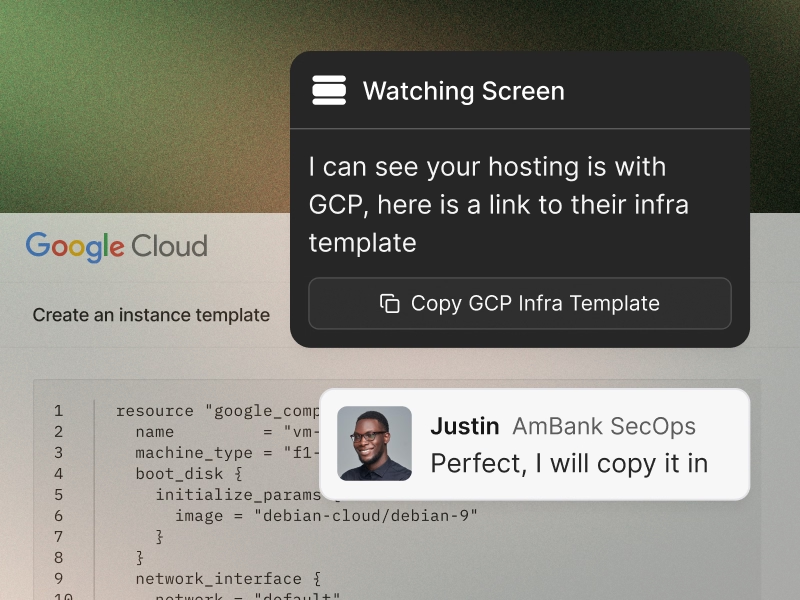
Agents that talk to the user
Cora acts on data about the user, what they clicked, what they didn't, where the health score dropped, which playbook should fire. The data is useful and the workflow automation is genuinely capable. What it doesn't include is the actual conversation with the user about what they're trying to do and why they're stuck. Quarterzip is that conversation.
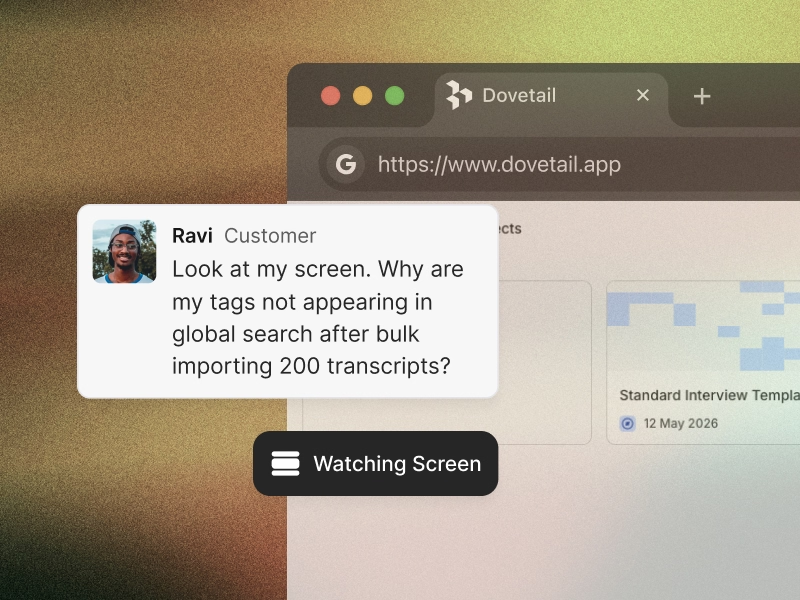
Multi-model agent using voice and screenshare
Guidance personalised to every users goals
Mirrors how humans naturally learn and collaborate
Activates AI features that the data layer can't fix
The activation gap on AI features isn't a workflow problem the CSM can solve with better alerts. The user looking at a new AI capability is trying to work out what it does, whether to trust it, and whether it's worth changing the way they've been doing the job for years. None of that surfaces in a usage signal until after the user has already decided. Quarterzip is in the conversation while the decision is being made.
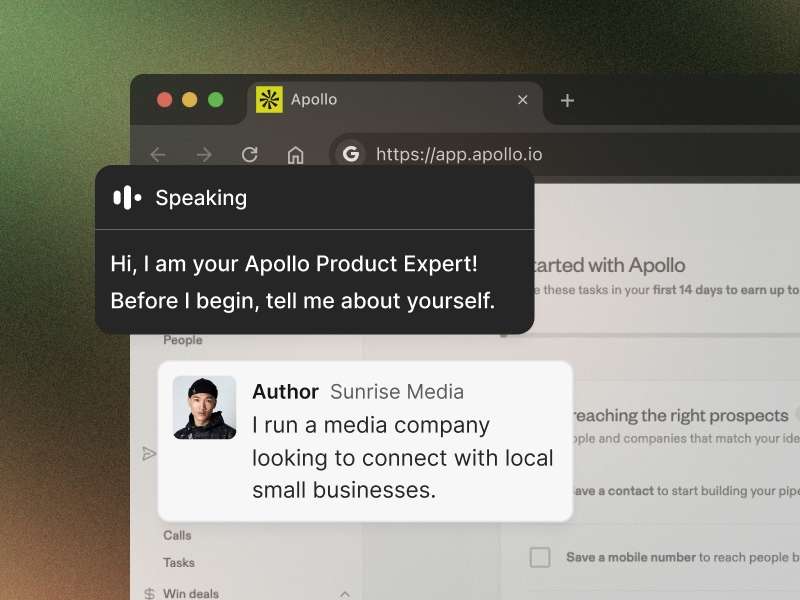
Guides users through goal-based workflows
Role-specific permissions and visibility
A product expert for every user
Operates at the diffusion layer, not the operational one
Cora's lift comes from making the post-sales team more efficient. Quarterzip's lift comes from making the product more usable to the people it was built for. Both are real, but they're measuring different things. Efficiency is a denominator move. Diffusion is a numerator move, it's the AI capability the company has already shipped actually reaching the users who pay for it.

Reaches users in real time
Activates users directly
Doesn't depend on the post-sales team to scale
No code, live in two weeks
Quarterzip's set up is done for you, meaing no engineering work on your end. Cora integrates into the existing post-sales stack, which depending on scope can take longer to implement and configure across the workflows it's automating.
No engineering work on your end
Live in two weeks, regardless of your existing stack
No integration project, no configuration cycle
Quarterzip is built different, by design.
Meets users where they are
Agentic interfaces - voice, screen, mobile, ambient - that activate every user, on every product.
Effortless integration
Live in two weeks, trained in your voice. Quarterzip's team handles setup end-to-end, trained on your product, your language, and your customers' most common questions.
Every session captures signal
Captures the why behind every interaction - goals, blockers, and what finally made it click.
Trusted by fast growing companies

“We see immense potential in Quarterzip’s ability to guide users in real time. Our platform involves complex, multi-step processes. Having Quarterzip’s AI voice agent support users contextually, right when they need it, is incredibly powerful. It’s a glimpse into how the next generation of onboarding, training and customer support experiences will feel.”

“Quarterzip changes the math on activation.
We can give every user a guided, personalized experience without throwing headcount at the problem.”
Ben Darlow
Product Executive

“In construction, software adoption succeeds when it feels effortless for teams in the field. Quarterzip’s vision for AI-driven, conversational onboarding captures that perfectly. It’s about making powerful tools feel intuitive from day one, and that’s a game changer for how we scale customer success.”

“Quarterzip changes the math on activation.
We can give every user a guided, personalized experience without throwing headcount at the problem.”
James Baker
CEO

“As we continue to scale, delivering a consistent and engaging onboarding experience is essential. Quarterzip stood out because it transforms onboarding from a static checklist into an intelligent, continuous experience that adapts to every user. Our team can create guided, personalized onboarding experiences instantly with zero engineering.”

“Quarterzip changes the math on activation.
We can give every user a guided, personalized experience without throwing headcount at the problem.”
Chris Caigou
Chief Customer Officer
“Quarterzip changes the math on activation. We can give every user a guided, personalized experience without throwing headcount at the problem.”
“Quarterzip changes the math on activation.
We can give every user a guided, personalized experience without throwing headcount at the problem.”
James Boone
Sr. Director

“We see immense potential in Quarterzip’s ability to guide users in real time. Our platform involves complex, multi-step processes. Having Quarterzip’s AI voice agent support users contextually, right when they need it, is incredibly powerful. It’s a glimpse into how the next generation of onboarding, training and customer support experiences will feel.”

“Quarterzip changes the math on activation.
We can give every user a guided, personalized experience without throwing headcount at the problem.”
Ben Darlow
Product Executive

“In construction, software adoption succeeds when it feels effortless for teams in the field. Quarterzip’s vision for AI-driven, conversational onboarding captures that perfectly. It’s about making powerful tools feel intuitive from day one, and that’s a game changer for how we scale customer success.”

“Quarterzip changes the math on activation.
We can give every user a guided, personalized experience without throwing headcount at the problem.”
James Baker
CEO

“As we continue to scale, delivering a consistent and engaging onboarding experience is essential. Quarterzip stood out because it transforms onboarding from a static checklist into an intelligent, continuous experience that adapts to every user. Our team can create guided, personalized onboarding experiences instantly with zero engineering.”

“Quarterzip changes the math on activation.
We can give every user a guided, personalized experience without throwing headcount at the problem.”
Chris Caigou
Chief Customer Officer
“Quarterzip changes the math on activation. We can give every user a guided, personalized experience without throwing headcount at the problem.”
“Quarterzip changes the math on activation.
We can give every user a guided, personalized experience without throwing headcount at the problem.”
James Boone
Sr. Director
FAQ
Is Quarterzip a Cora AI alternative?
The two products share a buyer and overlap on outcomes, but they sit at different layers of the post-sales problem. Cora is workflow automation for the post-sales team, signals, playbooks, escalations, orchestration across the customer lifecycle. Quarterzip is the interface layer for users: a voice agent that talks to the user, watches their screen, and walks them through new capability in the moment. Teams sometimes evaluate both, and sometimes both end up deployed, but they're built for different parts of the same problem.
Why does Quarterzip work at the interface and not the workflow?
Diffusion happens in the moment a user encounters new capability and decides what they think of it. Workflow automation can act on signals about what the user has done, but it can't be in the conversation while the decision is being made. AI features especially get accepted or rejected in the user's first few sessions, and the decision is hard to reverse later. Quarterzip is built to be in the room when that decision is forming.
Does Quarterzip replace the CSM team?
No. Quarterzip handles the repeatable conversations that follow a pattern, the activation calls, the feature walkthroughs, the moments where a user needs to be guided through something, which frees CSMs to focus on the strategic relationships, expansion, and the work that needs a human. Apollo runs both: Quarterzip on activation, CSMs on the customer relationships that depend on a human owner.
Does Quarterzip give me analytics like Cora?
Quarterzip captures qualitative and behavioural insight from every call: user goals, friction, sentiment, what users did on screen, and where they got stuck. The Insights Hub surfaces all of it. Cora's analytics are oriented toward post-sales workflow signals, health scores, usage patterns, expansion triggers, across the customer lifecycle. The two produce different shapes of data because they're acting on different parts of the problem.